User Manual for VesselAI Platform

🚒 We are pleased to share – VesselAI User Manual

πŸ“˜ This public deliverable provides a structured overview of the VesselAI platform, presenting its core components, functionalities, and main user workflows. The manual explains how the platform supports the full maritime data lifecycle, from data ingestion and storage to data exploration and analysis, processes, data streaming, data governance, AI services, workflow orchestration, and digital twin (DT) and decision support system (DSS) capabilities. It is designed to help users transform raw maritime data into actionable insights for vessel performance analysis, operational optimization, and environmental and economic assessment.

βš“ In a sector where digital platforms are often proprietary and access to data is restricted, wider collaboration and innovation can be difficult. Limited data sharing reduces opportunities for research communities and R&D partners to validate AI and machine learning methods on critical maritime datasets. In this context, TwinShip will further strengthen its DT/DSS framework by leveraging the VesselAI digital platform, originally developed through the collaborative VesselAI H2020 project.

πŸ” As an open-source platform with a sophisticated architecture for large-scale data processing and advanced AI/ML applications, VesselAI is designed to support secure and seamless data sharing in the maritime sector. It introduces a federated data space with dedicated encryption mechanisms for maritime data, while also promoting semantic interoperability through shared vocabularies and ontologies, enabling a common understanding of exchanged data across different systems.

🌍 With implementations already in place at ICCS and DSSLab in Athens, and an upcoming setup at UiT in Tromsø, the platform is expanding its reach and value for academia, research, and industry stakeholders. This also strengthens resilience through a data backup strategy aligned with the 3-2-1 Rule.

πŸ‘ A big thank you to all partners and contributors involved in this work.

Now you download the deliverable from: https://www.researchgate.net/publication/403268274_User_Manual_for_VesselAI_Platform

Β 

deliverables

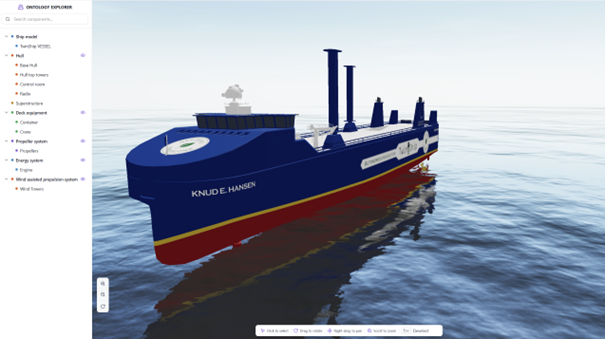
TWINSHIP ONTOLOGY

🚒 Exciting milestone for the TwinShip Consortium project!

πŸ”— https://ontology.twin-ship.eu/index-en.html

We're thrilled to announce the publication of the first version of the TwinShip Ontology - a foundational step toward standardizing the digital twin in shipping. 🌐

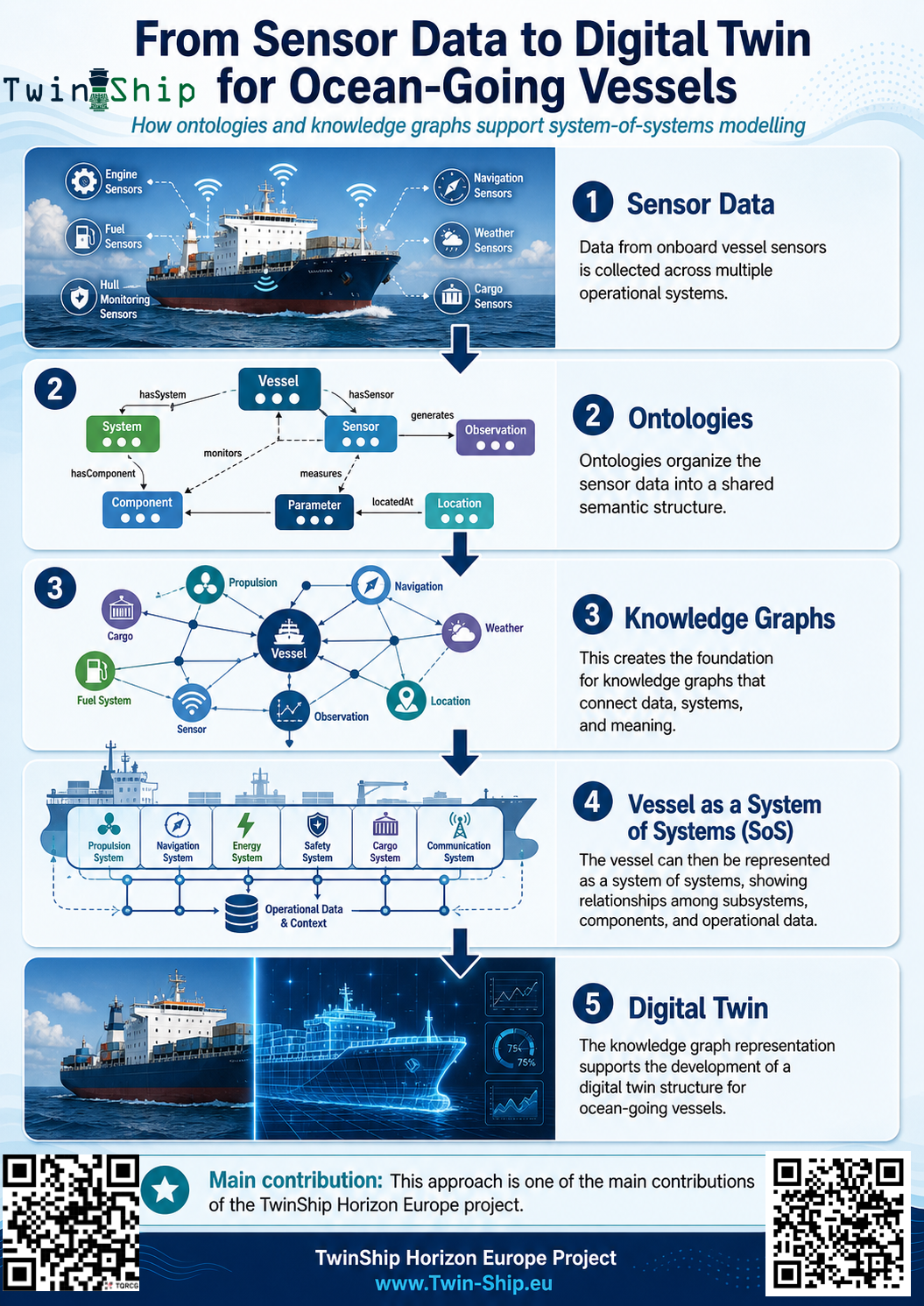
A significant portion of these ontologies is grounded in the IMO Compendium - the internationally recognized framework designed to enable seamless, standardized communication between vessels and ports. By building on this foundation, we ensure our work aligns with the broader maritime ecosystem from day one.

So, what does this mean in practice?

While these ontologies are developed to support vessel Digital Twin (DT) model development, their impact extends far beyond a single project:

βœ… Shipping companies can standardize data collection and processing across their fleets
βœ… DT model development can follow a consistent, interoperable framework
βœ… Applications like voyage optimization can be built on shared, reliable data structures

What's next?

The road ahead is equally exciting. Our next milestone is the development of knowledge graphs for the TwinShip pilot vessels - which will serve as the backbone for the actual DT model development to follow.

The maritime industry is at the beginning of a digital transformation, and ontologies like these are the quiet infrastructure that will make it scalable, interoperable, and impactful.

πŸ‘‰ Explore the IMO Compendium: https://imocompendium.imo.org/public/IMO-Compendium/Current/index.htm

We'd love to hear from maritime professionals, researchers, and technology partners - how is your organization approaching data standardization for digital twins?
onto

infographic

TwinShip at the Port of Valencia

Β 

Today, the TwinShip Horizon Europe project team visited the Port of Valencia to discuss future port needs and explore how our Digital Twin (DT) models and Decision Support System (DSS) tools can support next-generation, sustainable port operations.

This collaboration is a key step toward aligning smart port development, decarbonization goals, and advanced maritime digitalization in future ports.
tst

Β 

generalassembly

Successful completion of the First Year of the TwinSip project

🌊 TwinShip Futuristic Digital Technologies Visit Future Ports

Today, 11th February 2026, we held the 2nd General Assembly of the TwinShip Consortium Horizon Europe project ( https://twin-ship.eu/ ) at the Port of Valencia, Spain – key milestones in advancing maritime digitalization for decarbonization.

🚒 The TwinShip consortium unites leading maritime technology providers, shipping companies, classification societies, ports, software developers, and research institutions. Together, we are developing an open-source digital platform powered by data, advanced AI/ML, and Digital Twin technologies for:

βœ… Current vessels
βœ… Current & emerging green fuels and technologies
βœ… Futuristic vessel concepts and voyage optimization applications

At the heart of TwinShip is a DT-enabled Decision Support System (DSS) designed to:

βœ… Support the industry’s digital transformation
βœ… Accelerate decarbonization pathways
βœ… Enable the adoption of clean fuels, renewable energy & unmanned vessels

With our pilot vessels and Futuristic Unmanned Vessel Concept, TwinShip is helping chart the course toward a sustainable, innovative, and resilient maritime sector.
ga2

generalassembly

Page 5 of 10